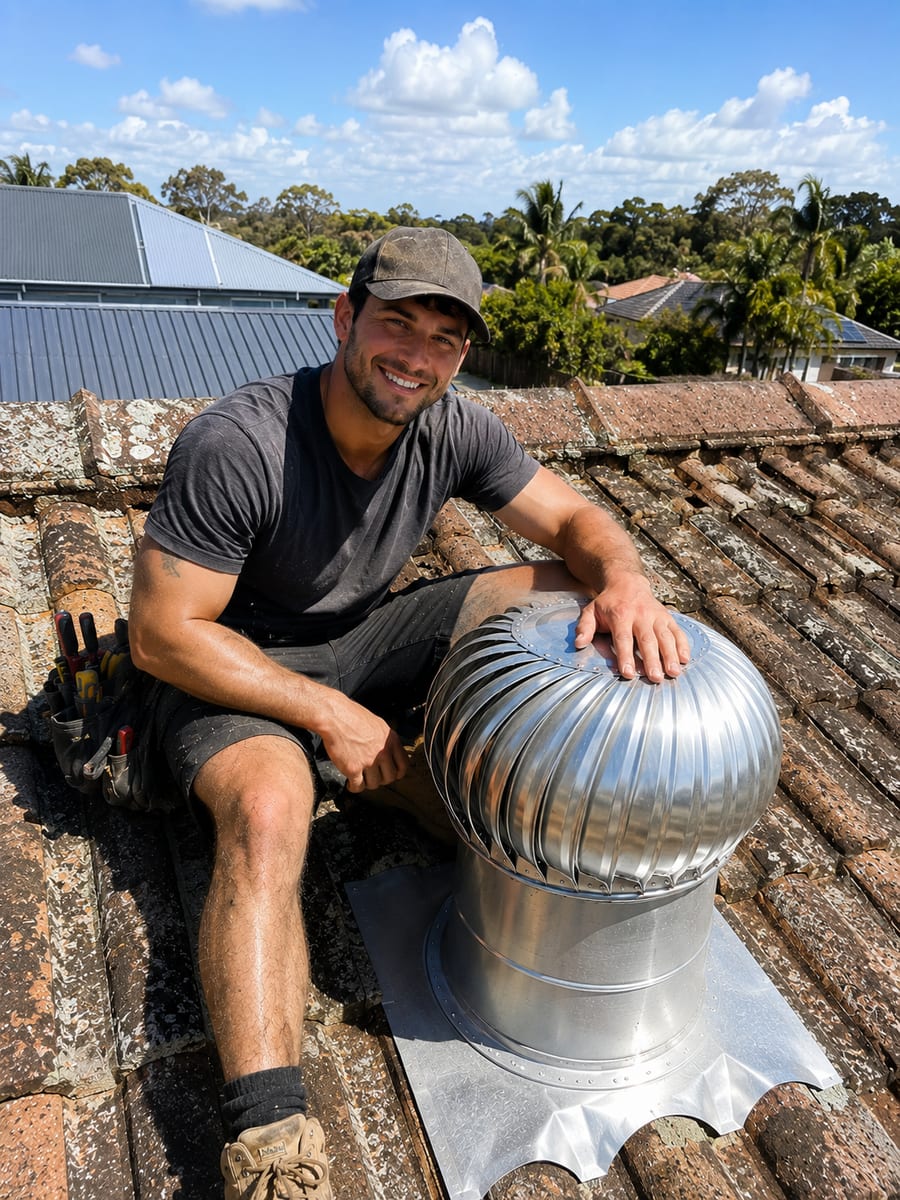
How Many Whirlybirds Do I Need? A Perth Roof Size Guide
By Dave · 28 January 2026 · 3 min read
The working rule is one 300mm whirlybird per 50–60m² of ceiling area. Take your house's floor area under roof, divide by 55, round up. A 200m² four-bedroom home lands on four units. A 120m² villa lands on two.
That gets you close. Three things move the number.
1. Roof pitch
A steeper roof holds a bigger volume of air above your ceiling, and hot air stratifies — the hottest layer sits right up at the ridge. A 30-degree tile roof genuinely has more to shift than a 15-degree Colorbond roof over the same floor plan, so it wants an extra unit more often than not.
2. Roof colour and material
Dark roofs run hotter. Monument and Basalt Colorbond on a February afternoon in Perth will push cavity temperatures well past what a light-coloured tile roof reaches on the same day. Same house, same ceiling area, more heat to remove.
3. Intake venting — the one everyone misses
This is the big one. A whirlybird can only extract as much air as can get back in. If your eaves are boxed in, lined without vents, or the house is double-brick with minimal eave overhang, you can bolt six turbines to the roof and still not move much air.
Adding eave vents is usually cheaper than adding more whirlybirds, and it makes the units you already have work properly. Any quote that jumps straight to "you need six" without asking about your eaves is selling units, not solving a problem.
A rough guide by house size
- Under 120m² — 2 units
- 120–180m² — 3 units
- 180–250m² — 4 units
- 250–320m² — 5 units, or 1–2 solar vents
- Over 320m² — worth costing solar vents against turbines
Add one to those numbers for a dark roof, a steep pitch, or a west-facing roof with no shade. Subtract nothing — under-ventilating is the more common mistake.
Where they go matters as much as how many
Units should sit high on the roof, close to the ridge, and be spread across the roof rather than clustered on one side. Four whirlybirds in a row along one slope will short-circuit — air gets drawn between them rather than up through the whole cavity.
In Perth the preferred exposure is the western or south-western slope, so the turbines are catching the sea breeze at its strongest during the hottest part of the afternoon.
When more units is the wrong answer
If your ceiling area is large, your roof is dark, and your eaves are limited, five turbines will disappoint you. That is the point at which a single solar vent — which pushes air actively rather than waiting for wind — does more for the same money.
Two questions on the phone will tell you which situation you are in. Give Dave your roof type, ceiling size and whether your eaves are vented, and you will get a straight recommendation and a fixed price.
Want a fixed price for your roof?
Tell Dave your roof type and rough ceiling size through the form and you will have a fixed price the same business day. No site visit, no obligation.